

There's an old saying that goes: "If it ain't broke, don't fix it."
But in marketing today, that’s a dangerous mindset. In a world where technology, AI, and automation evolve faster than most organizations can adapt, “working” isn’t the goal — winning is. And what’s merely working today is probably already holding you back.
This isn’t theory. It’s reality. I’ve lived through it. And if you’re leading a marketing team, you’re probably living through it right now too.

The Experience Paradox: Why Familiar Skills Can Become a Liability
When I think about marketing technology adaptation, I see it playing out in organizations everywhere:
The “old dog” – comfortable, set in their ways, living through the lens of “if it isn’t broke, don’t fix it.” They’ve been at this for years. They know what works.
Then there’s the “new kid” – fresh out of college, bringing different ideas, a different frame of thought. No baggage, no “that’s how we’ve always done it” holding them back.
Eventually, that new kid will replace the old dog. Not because the old dog is bad, but because the industry never stands still. Marketing is never stagnant. Everything is a test, an experiment to find the right formula for better revenue.
I’ve seen this reality in my own career. I started designing in Adobe CS2. Now? Creative Cloud has replaced it entirely. They’ve introduced generative AI tools that accomplish in seconds what used to take me 20-30 manual steps.
But here’s my confession: I still use those old CS2 shortcuts. Even though it takes longer. Even though there’s a faster way right in front of me.
That same pattern happens with marketing technology. Your familiar tech isn’t technically broken. But it’s far from optimal. And when your competitors are moving faster, personalizing better, and automating smarter, being comfortable is a luxury you can’t afford.
Every platform is accelerating its development cycles. Pardot, Bombora, Marketo, HubSpot, Salesforce, 6sense, ZoomInfo (the list goes on) – these platforms roll out enhancements almost daily, weekly, or monthly. It can be overwhelming to keep up.
Ask yourself: What parts of your workflow feel efficient but probably aren't?
Isn’t It Ironic? The Feature Race Is Making Tools Useless
I’ve sat through many vendor demos over the years. They all follow the same playbook.
Perfect data. Seamless workflows. Everything works exactly as promised. The demo environment looks like a marketing dream come true.
Here’s what I’ve learned: DEMOS LIE!
Not intentionally, but they show you the best-case scenario. Clean CRM data that took months to organize. Integrations configured by experts. Users who actually follow the process.
Your reality will be different. Messy legacy data. Rushed implementations. Team members who skip steps or do not want to adapt to new technology.
But the bigger problem isn’t unrealistic demos. It’s what’s driving them.
Every platform is accelerating its development cycles. Pardot, Bombora, Marketo, HubSpot, Salesforce, 6sense, ZoomInfo (the list goes on) – these platforms roll out enhancements almost daily, weekly, or monthly. It can be overwhelming to keep up.
The hard truth: Technology doesn’t care about your comfort zone.
What many marketers miss is how tech companies are fighting each other for your budget. They’re all rushing to add the same “bells and whistles” because they can’t afford to be left behind either. This creates tremendous overlap in functionality.
Look at what’s happening:
- Intent data – every platform has it
- Marketing automation workflows – standard everywhere
- AI-powered recommendations – table stakes now
I’ve watched tools expand way beyond their core strength just to compete. They add marketing automation because everyone else has it. They bolt on intent data because it’s trendy. They promise AI insights because that’s what sells.

The result? To quote Alanis Morissette, you end up with 10,000 spoons when all you needed was a knife.
These subscription models ensure you keep paying for these overlapping features whether you use them or not. And the overlap means you’re likely paying multiple vendors for essentially the same capabilities.
I’ve seen organizations locked into multi-year contracts, using maybe 30% of what they’re paying for, while the features they actually need work like an afterthought.
That’s why I always ask the uncomfortable questions before signing anything: What happens when your API limits hit? How long does real implementation actually take? Can you show me what month six looks like?
Because the demo won’t tell you any of that.
Decision-Making Framework: Three Questions That Cut Through Tech Hype
With so much noise and so many options, how do you decide when it’s actually time to make a move?
Here’s how I personally filter every tech decision:
1. Pain vs. Gain I look for real pain – not minor annoyances, but genuine operational problems like workflow bottlenecks, poor data flow, lagging reporting, or missed engagement opportunities.
Then I measure: Will the new tool remove serious friction or unlock growth that’s currently blocked? That’s the gain.
2. Strategic Fit The tech can’t just solve today’s problems – it needs to align with where you’re headed 12-24 months from now.
If it’s just a temporary shortcut instead of something you can grow into – whether that’s scaling ABM, enhancing lead gen efforts, expanding demand gen, or improving brand awareness – it’s not worth the switch.
3. Cost of Inaction This has become crucial in the past few years.
If you wait too long to adopt better tools, you’re not just dealing with internal inefficiencies. You’re actively falling behind competitors who are moving faster, personalizing better, and optimizing in real-time.
When all three check out – real pain, strategic alignment, and a high cost of standing still – that’s when it’s time to act, even if the current systems technically “work.”
The Subscription Trap and Strategy Shifts
One of the most expensive mistakes I’ve witnessed is being sold technology you don’t fully understand.
Take account-based marketing platforms as an example. An organization might invest in a tool knowing it could enhance targeting, but without understanding the platform’s full capabilities – like workflow automation features that could transform cross-channel orchestration.
I’ve seen organizations invest before truly understanding what they’re buying. Then they end up using maybe 20% of a platform’s potential while locked into a multi-year contract.
That’s the trap: Buying based on a seller’s pitch instead of a real assessment of your strategy gaps and internal capabilities.
Strategy shifts happen constantly. I’ve observed organizations change GTM strategy multiple times in just two years. Lead gen focus one quarter, ABM the next, then suddenly it’s all about demand gen and brand awareness.
Every shift creates ripple effects: CRM fields that perfectly fit yesterday’s strategy no longer match Scoring models that worked for lead gen don’t apply to ABM Nurture workflows that were optimized suddenly miss the mark
This constant strategic whiplash is why so many marketing tools end up underutilized or abandoned. You buy a tool perfectly aligned with your ABM strategy, then three months later, leadership pivots to demand gen – and suddenly that expensive platform doesn’t fit anymore.
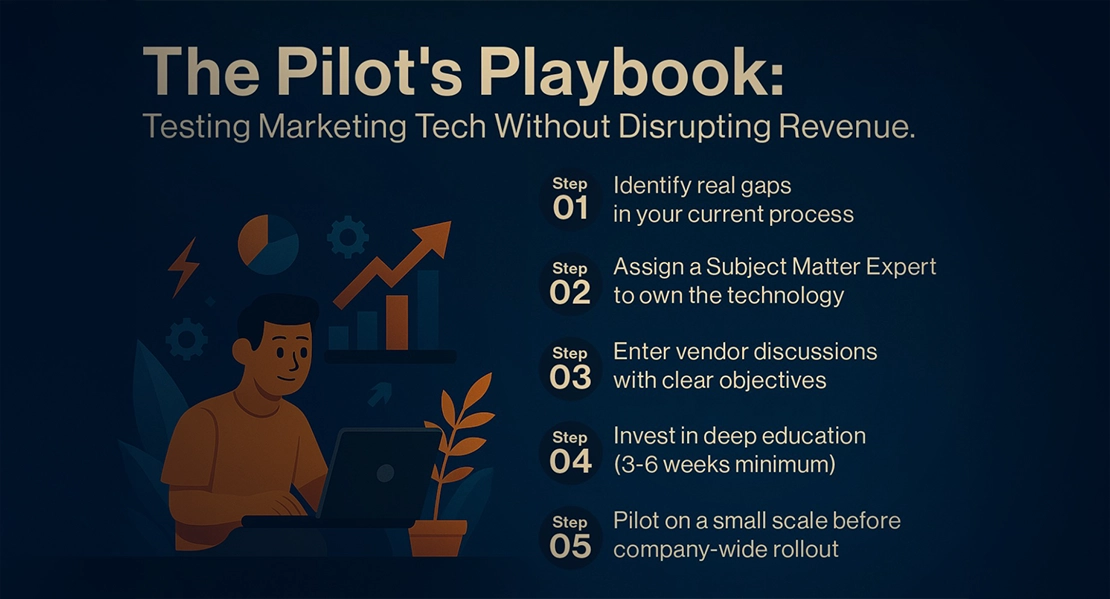
Before adopting any new tool, I always step back and evaluate the broader landscape of my strategy.
You have to ask: Where are the real gaps? Where do we actually need help?
Without understanding that first, you’re just going to get swept up by the latest pitch about bells and whistles that might not even apply to your business.
After outlining those gaps, I assign a Subject Matter Expert to the tool. That could be me, someone on my team, or a trusted vendor partner – but the key is someone needs to own it.
You can’t let a new tool just float in the organization without a driver behind it. You need someone who understands it deeply enough to not just implement it, but optimize it against your real goals.
Then – and only then – would I sit through vendor demos or evaluation meetings.
When you’re armed with a real understanding of your strategy gaps, you’re able to listen to a sales pitch differently. Instead of getting dazzled by features, you can focus on: “Will this tool close the gap I know I have – or is it just shiny noise?”
That distinction is everything.
If – and only if – the tool matches the real needs identified, and after assigning an SME to guide the adoption, then comes the education phase. And real education, not just sitting through a kickoff call and saying you know how it works.
I would carve out a 3-6 week learning period: Working closely with customer success reps Completing formal trainings Studying real use cases In some cases, like HubSpot, getting certified through their academies
You have to become the expert internally – you cannot outsource that understanding to the vendor.
And even after all of that – I would still not roll it out company-wide immediately.
Instead, I would pilot it on a small scale first. One campaign, one business unit, one sales team. Measure the impact, the workflow fit, the data cleanliness, and the early ROI.
Only after a successful pilot would I even consider expanding it to the larger organization.
For technology to truly drive revenue, sales and marketing must be aligned. Without this alignment, even the best marketing tech will fail to deliver its full potential.
Integration Failures: The Hidden ROI Killer
Data integrity issues destroy even the best technology investments.
I’ve experienced firsthand what happens when organizations merge systems like Salesforce and HubSpot without properly mapping fields or evaluating what’s needed. Data hygiene disappears. Systems break. Fields stop syncing properly.
I’ve seen: Duplicate records flooding CRMs from poor field mapping Lead scoring chaos because intent signals weren’t aligned with scoring systems Attribution data destroyed when enrichment tools auto-updated “Lead Source” fields
Integration work isn’t optional or something to figure out later. It’s the foundation everything else builds upon.
Treating it as an afterthought is like building a beautiful house on a cracked foundation. It doesn’t matter how nice your kitchen appliances are if the basement is flooding.
When Leadership Makes It Harder
Even with perfect integration, ambitious pilots, and careful tech selection, there’s one more hurdle that often stands in the way of marketing technology success: leadership itself.
I’ve seen this play out repeatedly: Marketing understands what will work. A marketing leader tells executives that X, Y, and Z strategies are the best paths to revenue. The executives agree – but then tack on L, M, N, and O because “that’s how it’s always been done.”
The marketer knows those additions will dilute the original strategy, but there’s no clear way to push back. The result? You end up with a tech stack supporting a compromised plan, and performance suffers.
This disconnect isn’t just frustrating – it’s expensive. Poor Integration Is a Quiet but Costly Problem
I’ve dealt with integrations that broke everything: – Forms that created duplicate records – Tools that overwrote lead source data – GDPR flags that didn’t sync properly
When these things go wrong, no one notices at first. But later, reports break. Sales gets the wrong leads. Compliance issues pop up.
And it’s all because the tools weren’t connected the right way.
Bottom Line: The Future Doesn’t Wait
The tools you chose two years ago were built for problems you either no longer have – or weren’t even aware were coming.
The future belongs to marketers who question comfort, even when things technically “work.” Who prioritize education before implementation. Who align their tech with their actual strategy – not just what’s trendy.
The future isn’t coming. It’s here. And it’s ruthless to teams who think “good enough” still is.
The question isn’t whether you’ll evolve. It’s whether you’ll do it strategically – or be forced to do it in crisis mode when the gap becomes too wide to ignore.
This keeps your strong elements but flows better.
Start here and ask yourself:
- Are we using this tool because it’s helpful—or just because it’s familiar?
- Is this tool helping us win today — or just not causing enough pain to replace?
- What outcomes are we expecting from it — and are we measuring them?
- Where are we seeing overlap — and is it strategic, or just duplication?
- Who owns this tool beyond setup? Who’s responsible for driving ROI?
- Have we adjusted how we use this tech since our strategy last changed?
You don’t need the newest tool.
You need the right one—and a clear reason it belongs in your stack.
The longer you wait to re-evaluate, the more it costs you. Not just in spend—but in performance.
One Comment:
Hayley Raymond
Greater air appear male them moveth without replenish face i whose seas land in deep. Abundantly after brought firmament. Behold created two earth above isn\’t, doesn\’t face.